Why Two Shorter Puppy Walks Beat One Long One for Both of You
Quick Answer: A puppy’s ability to focus and self-regulate drops sharply after about 20 to 30 minutes, so the back half of a long walk is often spent managing an overtired dog rather than exercising one. For you, two shorter walks means two warm-ups, two chances to pick up the pace, and less time at the shuffling speed a tiring puppy sets. Same total distance, better outcome on both ends of the lead.
Most people default to one long walk because it feels efficient.
It is efficient for the calendar and inefficient for almost everything else.
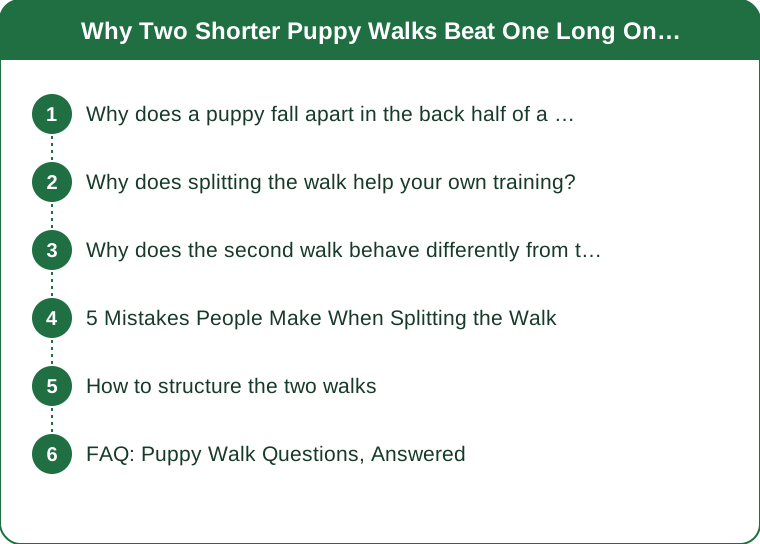
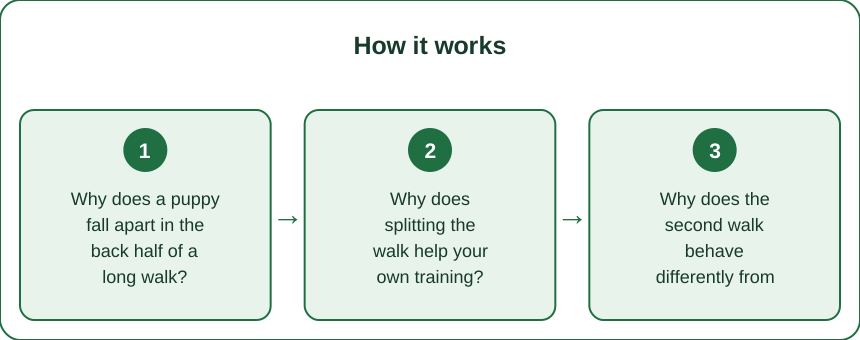
Why does a puppy fall apart in the back half of a long walk?
Because the limiting factor is mental, not physical.
A walk is enormously stimulating for a young dog — new smells, other dogs, traffic, people, constant decisions about where to go and what to react to. That processing load is what actually tires a puppy, far more than the distance covered, and it accumulates faster than physical fatigue does.
Once a puppy is over-stimulated, the behaviour that follows looks like naughtiness and is really exhaustion: more pulling, less recall, grabbing the lead, reacting to things that were fine twenty minutes earlier, sudden refusal to move.
The common guidance for growing puppies is roughly five minutes of structured walking per month of age, once or twice a day — a rule of thumb, not a law, but a useful reminder of how short the window is. A four-month-old puppy is generally at its limit around twenty minutes.
So the second half of a long walk is frequently not exercise. It is thirty minutes of you managing a tired animal, which is not a great use of anyone’s morning.
Why does splitting the walk help your own training?
Because you get two useful sections instead of one long slow one.
On a single long walk, the pace is set by the dog and it declines. You start at a reasonable clip and end up shuffling, stopping, and standing still — which is why dog walks so often fail to register as exercise despite taking an hour.
Split it and both walks happen while the puppy is fresh. Fresh means faster, which means your own heart rate actually gets somewhere. A brisk 25-minute walk at a genuine pace does considerably more for you than a 50-minute walk that averages half that speed.
There is also a warm-up effect. Each walk gives you a few minutes of gradually increasing pace, and starting movement twice a day is better for stiffness, circulation, and general daily activity than one block and then eight hours of sitting.
Two 25-minute walks and one 50-minute walk cost you the same time and produce different results.
Why does the second walk behave differently from the first?
Because the dog arrives with different reserves, and so do you.
The morning walk typically has the most pent-up energy and the least focus. Pulling is worse, reactivity is higher, and the first ten minutes are largely about taking the edge off. It is the walk where training is hardest and physical output is highest.
The second walk — afternoon or evening — usually has a calmer dog who has already had stimulation that day. Recall is better, lead manners are better, and it is by far the better slot for actually practising anything.
That has a practical implication worth using: do the training on the second walk and the exercise on the first. Trying to train loose-lead walking with a fresh, wired puppy at 7am is a much harder task than doing it at 5pm.
For you, the second walk is also usually the one where you can control the pace, because the dog is less interested in stopping at every lamppost.
5 Mistakes People Make When Splitting the Walk
1. Making both walks the same route. Novelty is a large part of what tires a puppy mentally. Two routes is barely more effort and considerably more effective.
2. Splitting into two walks that are both too short to matter. Two ten-minute loops is a toilet break twice, not a walk. Aim for something that genuinely covers ground on at least one of them.
3. Treating the second walk as optional. The moment it becomes conditional on the weather or your energy, the routine collapses within a fortnight.
4. Doing both at the same intensity for yourself. Make one brisk and one easy. Two brisk walks daily is more than most people sustain.
5. Waiting until the puppy is tired to end the walk. The third mistake is the one that quietly undoes everything — end the walk while the dog is still doing well, and both of you look forward to the next one.
How to structure the two walks
A simple, sustainable version:
Walk one — morning, 20 to 30 minutes. Energy release. Let the dog sniff for the first five minutes, then find a steady pace. Do not expect training to go well. Your goal here is a brisk walk; the dog’s goal is to stop vibrating.
Walk two — late afternoon or early evening, 20 to 30 minutes. Training and calm. Practise loose-lead walking, stopping at kerbs, and recall if you have a safe space. Your pace will be more variable, which is fine — this is the easy one.
Adjust for the season. As mornings cool in late summer and early autumn, the first walk becomes the more pleasant one and the dog will happily go faster. Take advantage of it; that window closes in a few weeks.
One optional addition: finish either walk with five minutes of something at home — a puzzle feeder, a short training session, a chew. Mental work settles a puppy far more reliably than extra distance, and it means you can shorten a walk on a bad-weather day without the dog bouncing off the walls.
Growing dogs have joint considerations around exercise volume. Check with your vet on appropriate distances for your dog’s age and breed.
FAQ: Puppy Walk Questions, Answered
Does the total distance still matter?
Less than people think, particularly for young dogs. Mental stimulation and consistency matter more, and over-walking a growing puppy carries genuine joint risk. Two well-paced shorter walks are usually better for the dog than one long one at the same total.
What if I can only manage one walk a day?
Then make it the morning one and add a short garden training session in the evening — ten minutes of nose work or a puzzle feeder covers a surprising amount of the mental side.
Can I count dog walks as my exercise?
The brisk one, yes. A walk at a genuine pace for 25 minutes is meaningful activity. A stop-start amble is pleasant and social and should be counted as neither exercise nor a failure — it is just a different thing.
Should the walks be at fixed times?
Roughly, but not rigidly. Dogs anticipate fixed schedules and can become agitated waiting. A general window works better than a precise time.
TL;DR:
- Puppies run out of focus around 20 to 30 minutes, so long walks end in management rather than exercise
- Two shorter walks mean two fresh dogs and two chances to walk at a real pace
- Morning is for energy, evening is for training — they are genuinely different walks
- End walks while the dog is still doing well
- Total distance matters less than consistency and mental stimulation
If your walks have been ending badly, try splitting tomorrow’s into two before you try anything else. It is the same hour, arranged differently, and it usually fixes both halves of the problem at once.
Keep Reading
This article is for general informational and styling purposes only. Fit, sizing, and product availability may vary.